
Introduction
In the modern world, most businesses are no longer limited to physical stores or offline advertising. With the rapid growth of the internet, smartphones, and social media platforms, marketing has shifted from traditional methods to digital platforms. This transformation has created a strong demand for professionals who understand how online marketing works.
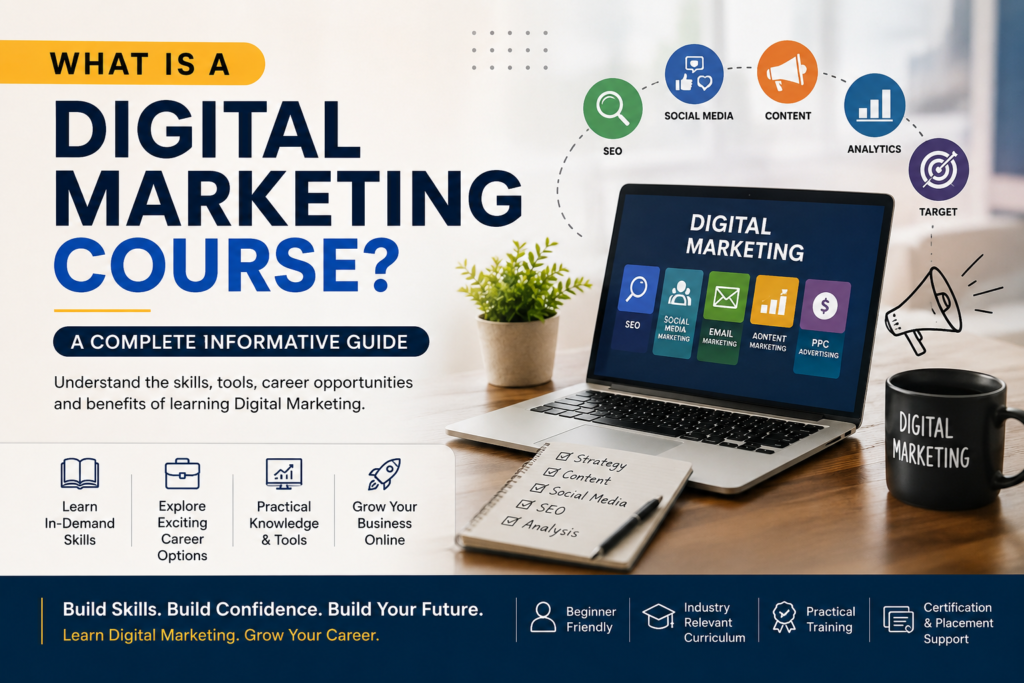
A Digital Marketing Course is a structured learning program designed to teach individuals how to promote products, services, or brands using digital channels such as search engines, social media platforms, websites, email, and paid advertising systems.
This article provides a detailed and purely informational explanation of what a digital marketing course is, what it includes, how it works, and why it has become an essential part of modern education and career development.
Understanding Digital Marketing
Digital marketing refers to the practice of promoting products or services using digital technologies and the internet. Unlike traditional marketing, which relies on newspapers, television, radio, and billboards, digital marketing uses online platforms to reach audiences.
These platforms include:
- Search engines like Google and Bing
- Social media platforms like Facebook, Instagram, LinkedIn, and X (Twitter)
- Video platforms like YouTube
- Websites and blogs
- Email communication systems
- Mobile applications
The main purpose of digital marketing is to connect businesses with potential customers where they spend most of their time—online.
What is a Digital Marketing Course?
A Digital Marketing Course is a training program that teaches the principles, strategies, and tools used in online marketing. It covers both theoretical concepts and practical applications.
The course is designed to help learners understand:
- How digital platforms work
- How online advertisements are created and managed
- How websites rank on search engines
- How content is used to attract audiences
- How customer behavior is analyzed online
The course is suitable for beginners as well as individuals who want to upgrade their marketing knowledge.
Objectives of a Digital Marketing Course
The main objectives of a digital marketing course include:
- Understanding online consumer behavior
- Learning how to create online marketing strategies
- Developing skills to manage digital campaigns
- Using analytics tools to measure performance
- Learning how to generate traffic, leads, and conversions
The course focuses on building practical skills that can be applied in real-world marketing scenarios.
Core Modules in a Digital Marketing Course
A complete digital marketing course usually consists of several important modules. Each module focuses on a specific area of online marketing.
1. Search Engine Optimization (SEO)
SEO is the process of improving a website’s visibility on search engines like Google.
It includes:
- Keyword research
- On-page optimization
- Off-page optimization
- Technical SEO
- Link building
The goal of SEO is to increase organic (non-paid) traffic to a website.
2. Search Engine Marketing (SEM)
SEM refers to paid advertising on search engines, mainly through platforms like Google Ads.
Key concepts include:
- Paid keyword targeting
- Ad campaign creation
- Budget management
- Performance tracking
SEM helps businesses get instant visibility on search engines.
3. Social Media Marketing (SMM)
Social media marketing involves promoting content and advertisements on platforms such as Facebook, Instagram, LinkedIn, and others.
It includes:
- Content planning
- Audience targeting
- Paid social campaigns
- Engagement strategies
Social media marketing helps in brand awareness and customer interaction.
4. Content Marketing
Content marketing focuses on creating valuable and relevant content to attract and retain audiences.
Types of content include:
- Blog articles
- Videos
- Infographics
- Social media posts
The purpose is to provide useful information that builds trust with the audience.
5. Email Marketing
Email marketing is the process of sending targeted emails to potential or existing customers.
It includes:
- Email campaign creation
- Automation workflows
- Newsletter design
- Lead nurturing strategies
It is widely used for customer retention and communication.
6. Website Development Basics
Many digital marketing courses include basic website development training.
Topics include:
- Domain and hosting setup
- Website design using CMS platforms like WordPress
- Landing page creation
A website acts as the foundation of digital marketing efforts.
7. Web Analytics
Web analytics involves measuring and analyzing website performance.
Tools like Google Analytics help track:
- Website traffic
- User behavior
- Conversion rates
- Traffic sources
This data is used to improve marketing strategies.
8. Affiliate Marketing
Affiliate marketing is a method where individuals earn commissions by promoting other companies’ products or services.
It involves:
- Product promotion
- Tracking referral links
- Commission-based earnings
Tools Used in Digital Marketing
Digital marketing professionals use various tools to execute and manage campaigns. Some commonly used tools include:
- Google Ads
- Google Analytics
- Google Search Console
- Meta Ads Manager
- Canva
- SEMrush
- Ahrefs
- Mailchimp
- WordPress
These tools help in planning, execution, and analysis of marketing campaigns.
Who Can Learn a Digital Marketing Course?
A digital marketing course is open to a wide range of learners, including:
- Students after school or graduation
- Job seekers looking for new career opportunities
- Business owners who want to grow online
- Freelancers interested in remote work
- Working professionals seeking skill enhancement
No specific technical background is required to start learning.
Skills Developed in a Digital Marketing Course
A digital marketing course helps develop several important skills:
- Analytical thinking
- Content creation
- Communication skills
- Data interpretation
- Strategic planning
- Problem-solving abilities
These skills are useful in multiple industries beyond marketing.
Career Opportunities in Digital Marketing
After completing a digital marketing course, individuals can explore various career roles such as:
- SEO Executive
- Social Media Manager
- Digital Marketing Executive
- Content Strategist
- PPC Specialist
- Email Marketing Executive
- Web Analyst
These roles exist in agencies, startups, corporate companies, and freelance markets.
Scope of Digital Marketing
The scope of digital marketing is expanding rapidly due to increasing internet usage and online business growth.
Key factors driving growth:
- Rise of e-commerce platforms
- Increased smartphone usage
- Expansion of social media
- Digital transformation of businesses
- Growing demand for online advertising
Digital marketing is now a core part of modern business strategies across industries.
Advantages of Learning Digital Marketing
Some key advantages include:
- Access to global career opportunities
- Flexibility to work remotely
- High demand across industries
- Multiple career paths
- Continuous learning opportunities
- Practical and industry-relevant skills
Duration of a Digital Marketing Course
The duration depends on the level of the course:
- Basic level: 2–3 months
- Advanced level: 4–6 months
- Professional level: 6–12 months
Most courses focus on practical training along with theoretical knowledge.
Conclusion
A Digital Marketing Course is a structured learning program that provides knowledge and skills required to promote businesses using online platforms. It covers essential areas such as SEO, social media marketing, content creation, email marketing, paid advertising, and analytics.
With the increasing shift toward digital platforms, understanding digital marketing has become an important skill in today’s economy. It offers opportunities across industries and continues to grow as technology evolves.
Digital marketing is not limited to a specific profession; it is a versatile skill that can be applied in multiple career paths and business activities.