
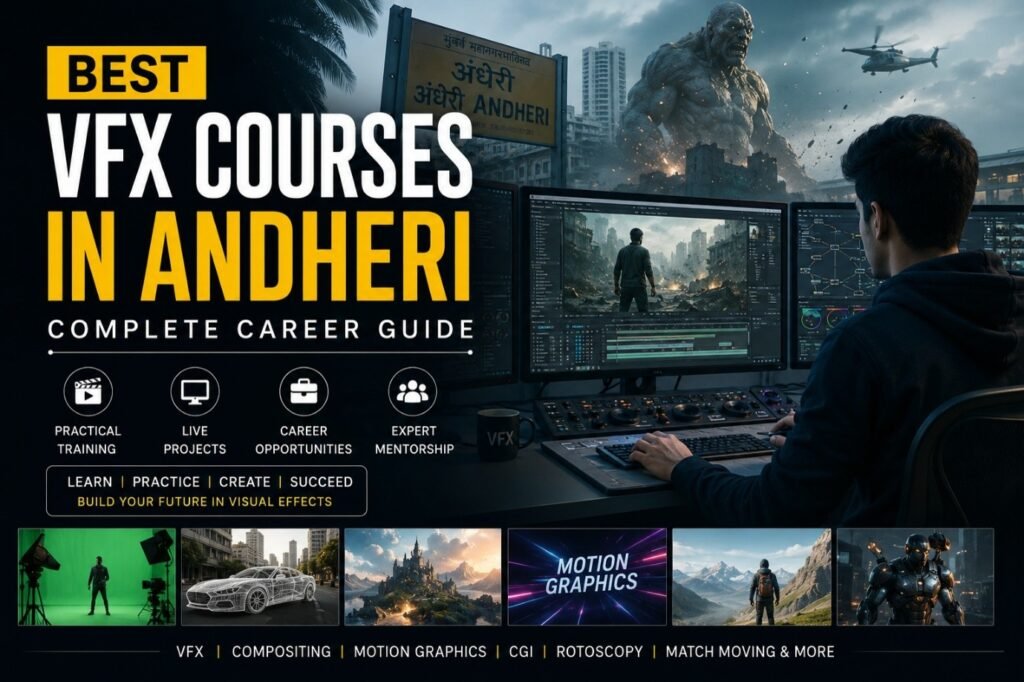
Introduction
The world of entertainment, advertising, gaming, and digital content has undergone a remarkable transformation over the last decade. Whether it is a blockbuster Bollywood movie, a Netflix web series, a high-budget advertisement, or a visually engaging YouTube video, visual effects have become an essential part of modern storytelling. As technology continues to evolve, the demand for skilled VFX professionals is growing rapidly across India and around the world.
Mumbai has always been considered the entertainment capital of India. With the expansion of OTT platforms, film production houses, advertising agencies, gaming companies, and digital media businesses, the need for trained visual effects artists is higher than ever before. This increasing demand has encouraged many students, graduates, and working professionals to explore career opportunities in visual effects and post-production.
As a result, many aspiring creative professionals are actively searching for VFX Courses in Andheri because Andheri has emerged as one of Mumbai’s most preferred educational and media hubs. The area offers excellent connectivity, proximity to production houses, creative agencies, and a thriving ecosystem for students looking to build a successful career in animation and visual effects.
However, choosing the right course is not simply about learning software. The modern VFX industry requires practical skills, creative thinking, project experience, and an understanding of professional production workflows. Students today are looking for institutions that provide hands-on learning, portfolio development, and industry-relevant training rather than purely theoretical education.
This comprehensive guide aims to help students understand the VFX industry, explore career opportunities, evaluate training options, and make informed decisions when searching for the right VFX Courses in Andheri.
What is VFX?
Visual Effects, commonly known as VFX, refers to the process of creating or manipulating imagery outside the context of a live-action shoot. These effects are integrated into videos, films, advertisements, television productions, and digital content to create scenes that would be difficult, dangerous, expensive, or even impossible to capture in real life.
When viewers watch superheroes flying through cities, fantasy creatures appearing on screen, futuristic environments, or realistic explosions, they are often witnessing the work of VFX artists.
Today, VFX is one of the most exciting creative and technical career fields because it combines imagination, storytelling, design principles, and advanced software tools.
Key Components of Visual Effects
CGI (Computer Generated Imagery)
CGI involves creating digital elements that can be seamlessly integrated into live-action footage. From animated characters to futuristic cityscapes, CGI has become a fundamental component of modern visual storytelling.
Rotoscoping
Rotoscoping is the process of manually tracing objects frame by frame to isolate them from a scene. This technique is widely used in film production and compositing workflows.
Compositing
Compositing involves combining multiple visual elements from different sources into a single scene. A compositor ensures that all elements blend naturally and appear realistic.
Motion Tracking
Motion tracking helps artists track the movement of objects or cameras so that digital elements can be accurately added to a live-action scene.
Match Moving
Match moving is closely related to motion tracking and helps create realistic interaction between computer-generated objects and real-world footage.
Green Screen Technology
Green screen compositing allows artists to replace backgrounds and place actors in virtual environments, making it one of the most commonly used techniques in the VFX industry.
Motion Graphics
Motion graphics involve animated text, logos, graphics, and visual elements used extensively in advertising, television, and digital marketing content.
VFX Pipeline
A VFX pipeline refers to the structured workflow followed during production. It includes:
- Pre-production
- Asset creation
- Animation
- Tracking
- Compositing
- Rendering
- Final output
Understanding the VFX pipeline is essential for students who wish to work in professional production environments.
AI in VFX Production
Artificial Intelligence is gradually becoming a valuable tool within the VFX industry. AI-assisted workflows are helping artists automate repetitive tasks, improve efficiency, enhance image quality, and accelerate content production. While AI is unlikely to replace creative professionals, it is becoming an important skill area for future-ready VFX artists.
Why VFX is a High-Demand Career in 2026
The visual effects industry has experienced consistent growth over the last few years, and industry experts expect this trend to continue throughout 2026 and beyond.
Several factors contribute to the increasing demand for VFX professionals.
Growth of OTT Platforms
Streaming platforms have transformed the entertainment landscape. Services such as Netflix, Amazon Prime Video, Disney+ Hotstar, and JioCinema continue investing heavily in original content.
Modern audiences expect cinematic-quality visuals, which has increased the demand for visual effects artists, compositors, motion graphics designers, and post-production specialists.
Expanding Film Industry
India produces one of the largest volumes of film content globally. Bollywood, regional cinema, and independent filmmakers increasingly rely on visual effects to enhance storytelling and production quality.
From historical dramas to action films and fantasy productions, VFX plays a critical role in modern filmmaking.
Gaming Industry Opportunities
The gaming industry is one of the fastest-growing sectors in the world. Game developers require artists who understand visual storytelling, effects creation, environment design, and cinematic sequences.
Many students searching for VFX Courses in Andheri are also interested in opportunities within gaming and interactive media.
Advertising Industry Demand
Brands are constantly looking for innovative ways to capture audience attention. As a result, advertising agencies frequently use motion graphics, CGI elements, and visual effects to create engaging campaigns.
This creates additional opportunities for skilled VFX professionals.
Rise of Content Creation
The creator economy has expanded significantly. YouTubers, influencers, production studios, and social media agencies often require VFX specialists to produce high-quality visual content.
Freelancers with VFX skills can find opportunities across multiple industries without being restricted to traditional film production.
Remote Work Opportunities
The creative industry has embraced remote collaboration. Many VFX artists now work with clients and studios from different countries while remaining based in India.
This flexibility makes visual effects an attractive career option for individuals seeking location-independent opportunities.
Salary Growth Potential
While entry-level salaries depend on skills, portfolio quality, and company size, experienced VFX professionals often enjoy strong career progression.
Professionals who continuously upgrade their skills and build impressive portfolios can access higher-paying opportunities in:
- Film production
- OTT platforms
- Advertising agencies
- Gaming studios
- International production houses
AI-Powered Creative Industry
As artificial intelligence becomes integrated into creative workflows, studios increasingly seek professionals who understand both traditional VFX techniques and emerging AI-powered production tools.
Students entering the field today have the advantage of preparing for future industry requirements while building strong creative foundations.
Why Students Prefer VFX Courses in Andheri
When students search for visual effects training in Mumbai, Andheri often emerges as one of the most preferred locations.
There are several practical reasons behind this preference.
Excellent Connectivity
Andheri is one of Mumbai’s most connected suburbs. The Western Railway line, Metro network, and road connectivity make commuting easier for students traveling from different parts of Mumbai and nearby areas.
This convenience significantly improves the overall learning experience.
Strong Educational Ecosystem
Andheri is home to numerous educational institutions, creative training centers, production companies, and media-related businesses. This creates an environment where students can access learning opportunities, industry events, and networking possibilities.
Access to Mumbai’s Entertainment Industry
Mumbai remains India’s entertainment capital. Students studying in Andheri often benefit from proximity to production houses, advertising agencies, media organizations, and creative studios.
This exposure can provide valuable insights into real-world industry practices.
Practical Learning Environment
Students increasingly prefer institutes that focus on project-based learning. Many modern training programs emphasize hands-on experience, allowing learners to work on assignments, simulations, and portfolio projects that reflect actual industry workflows.
Networking Opportunities
Building a successful creative career often depends on networking alongside technical skills.
Learning in a location like Andheri provides opportunities to interact with industry professionals, fellow creatives, and potential employers.
Better Career Accessibility
Students often choose VFX Courses in Andheri because the location provides easier access to internships, workshops, industry events, and employment opportunities within Mumbai’s thriving media ecosystem.
By studying in an environment closely connected to the entertainment industry, learners can gain a better understanding of professional expectations and career pathways.
How to Choose the Best VFX Institute in Andheri
Selecting the right training institute is one of the most important decisions for anyone planning to build a career in visual effects. While there are numerous institutes offering VFX Courses in Andheri, not all programs provide the same learning experience. Students should look beyond advertisements and evaluate how effectively a course prepares them for real-world production environments.
Practical Training Over Theory
Visual effects is a skill-based profession. Reading about compositing or motion tracking is very different from actually working on production footage and solving real project challenges. A good institute should focus on practical implementation rather than only classroom lectures.
Students should ideally spend a significant portion of their training working on projects, assignments, and portfolio-building exercises that simulate industry workflows.
Industry-Relevant Curriculum
The VFX industry evolves continuously. New software updates, AI-assisted tools, production pipelines, and creative techniques emerge regularly.
A quality VFX course should cover:
- Fundamental VFX concepts
- Compositing techniques
- Motion graphics
- Rotoscoping
- Tracking and match moving
- Green screen workflows
- Camera tracking
- Portfolio development
- Emerging AI-assisted production techniques
An updated syllabus helps students remain relevant in a competitive job market.
Experienced Trainers
Learning from experienced professionals can make a significant difference. Trainers who have worked on commercial projects often provide practical insights that go beyond textbooks.
Students benefit from understanding:
- Industry expectations
- Production challenges
- Client communication
- Team collaboration
- Professional workflows
These insights help bridge the gap between classroom learning and professional work environments.
Live Projects and Portfolio Development
Employers in the creative industry usually evaluate portfolios before offering opportunities. Therefore, students should prioritise institutes that help them build strong showreels and project portfolios.
A well-structured portfolio demonstrates:
- Technical skills
- Creative abilities
- Problem-solving capabilities
- Understanding of production workflows
Portfolio quality often has a greater impact than certificates alone.
Internship and Career Guidance
Although no institute can guarantee employment, career support services can be beneficial.
Students should evaluate whether the institute provides:
- Career counselling
- Resume guidance
- Interview preparation
- Portfolio reviews
- Internship opportunities
- Industry exposure sessions
These resources can help students navigate the transition from training to professional work.
Software Training
Modern VFX production relies heavily on specialised software. A comprehensive course should provide practical exposure to industry-relevant tools and workflows rather than focusing exclusively on software interfaces.
Offline Learning Benefits
While online education has become more accessible, many students still prefer classroom-based learning for creative disciplines.
Offline learning often offers:
- Direct interaction with trainers
- Better collaboration opportunities
- Faster doubt resolution
- Structured learning schedules
- Access to dedicated lab environments
This is one reason many learners actively search for classroom-based VFX Courses in Andheri.
About Future AI
When researching educational options for visual effects training, students often compare multiple institutes based on curriculum, learning methodology, practical exposure, and career support.
One of the institutions students may come across while exploring VFX Courses in Andheri is Future AI.
Future AI
Future AI focuses on helping students develop creative and technical skills through practical learning methodologies. Rather than limiting education to software demonstrations, the emphasis is on understanding how visual effects are created within real production environments.
The curriculum is designed to introduce students to various stages of modern VFX workflows, helping them understand both creative concepts and technical implementation.
Some of the areas students may explore include:
- Visual effects fundamentals
- Compositing techniques
- Motion graphics creation
- Green screen workflows
- Motion tracking
- Camera tracking
- Portfolio development
- Industry-standard production practices
A notable aspect of modern creative education is the growing integration of artificial intelligence tools. Future AI incorporates discussions around emerging technologies and how AI is influencing creative industries, helping learners understand evolving industry trends.
Students pursuing VFX education often seek opportunities to develop project portfolios alongside technical knowledge. Portfolio creation plays a critical role in showcasing abilities to potential employers, clients, and production studios.
By combining practical assignments, guided learning, and project-based exercises, students can gradually build confidence while preparing for professional opportunities in visual effects and digital content creation.
Modules Covered in VFX Courses
A comprehensive VFX course typically covers multiple disciplines because visual effects production involves a combination of creative and technical skills.
Below are some of the major modules commonly included in professional training programs.
Fundamentals of VFX
This module introduces students to the visual effects industry and provides a foundation in:
- Production terminology
- Industry workflows
- Types of visual effects
- VFX pipeline understanding
- Creative problem solving
Understanding these basics is essential before progressing into advanced production techniques.
Rotoscoping
Rotoscoping is one of the most fundamental skills in visual effects.
Students learn:
- Object isolation
- Frame-by-frame masking
- Matte creation
- Character extraction
- Scene cleanup techniques
Many professionals begin their careers by mastering rotoscoping workflows.
Compositing
Compositing is often considered the heart of visual effects production.
Students learn:
- Layer management
- Image integration
- Colour correction
- Visual continuity
- Multi-pass compositing
- Scene enhancement
Compositors play a vital role in creating realistic final outputs.
Motion Tracking
Motion tracking enables digital elements to move naturally within live-action footage.
Students learn:
- Object tracking
- Surface tracking
- Planar tracking
- Tracking data integration
This skill is widely used across films, advertisements, and digital content.
Match Moving
Match moving focuses on recreating camera movement digitally.
Students understand:
- Virtual camera setup
- Scene reconstruction
- CGI integration
- Perspective matching
This module is crucial for combining computer-generated elements with real-world footage.
Green Screen Compositing
Green screen techniques remain one of the most frequently used processes in modern production.
Students learn:
- Chroma keying
- Spill suppression
- Edge refinement
- Background replacement
- Environment creation
These techniques are commonly used in films, advertisements, and online content production.
Motion Graphics
Motion graphics combine design principles with animation techniques.
Students learn to create:
- Animated titles
- Logo animations
- Promotional content
- Social media visuals
- Broadcast graphics
This skill expands career opportunities beyond traditional VFX production.
CGI Integration
Computer-generated imagery is increasingly used across industries.
Students explore:
- CGI workflows
- Asset integration
- Environment creation
- Character integration
- Visual storytelling techniques
Matte Painting
Matte painting involves creating realistic digital environments and backgrounds.
This module helps students understand:
- Environmental design
- Digital landscape creation
- Scene extension techniques
- Background enhancement
Camera Tracking
Camera tracking allows artists to analyse and recreate camera movement for visual effects integration.
This skill is widely used in:
- Film production
- Advertising
- Virtual production
- Gaming cinematics
Video Editing
Basic editing knowledge is valuable for VFX professionals because it provides a broader understanding of post-production workflows.
Students often learn:
- Timeline management
- Scene sequencing
- Basic colour correction
- Audio synchronisation
Portfolio Development
Portfolio development is one of the most important components of professional training.
Students gradually create:
- VFX projects
- Motion graphics samples
- Compositing exercises
- Showreels
- Creative case studies
A strong portfolio can significantly improve employment and freelancing opportunities.
AI Tools for VFX Artists
The integration of AI into creative production is becoming increasingly common.
Students may explore:
- AI-assisted content creation
- Image enhancement
- Workflow automation
- Generative visual tools
- Productivity improvements
Understanding these technologies can help future professionals adapt to evolving industry requirements.
Freelancing Skills
Many students are interested in independent work opportunities.
Freelancing modules often cover:
- Client communication
- Project pricing
- Portfolio presentation
- Proposal creation
- Online profile development
These skills can help learners build independent careers alongside traditional employment opportunities.
Career Opportunities After VFX Course
One of the most common questions students ask before enrolling in a course is whether the field offers long-term career growth.
The answer depends largely on skill development, portfolio quality, practical experience, and continuous learning. Fortunately, the visual effects industry offers a wide range of career paths.
VFX Artist
VFX artists create visual enhancements that improve storytelling and audience engagement.
Responsibilities may include:
- Visual effects creation
- Scene enhancement
- CGI integration
- Shot development
Compositor
Compositors combine various visual elements into a seamless final image.
They work extensively with:
- Green screen footage
- CGI renders
- Matte paintings
- Motion graphics
Roto Artist
Roto artists create mattes and masks required for advanced compositing work.
This role often serves as an entry point into larger VFX pipelines.
Motion Graphics Designer
Motion graphics professionals create animated visual content used across:
- Advertising
- Television
- Digital marketing
- Corporate presentations
- Social media campaigns
Match Move Artist
Match move artists analyse camera movement and prepare data for CGI integration.
Their work is critical for creating believable visual effects.
Video Editor
Video editing remains one of the most versatile career options within digital media production.
Editors work on:
- Films
- Web content
- Corporate videos
- Advertisements
- YouTube productions
CGI Artist
CGI artists create digital environments, assets, and visual elements used in films, games, and commercials.
VFX Supervisor
Experienced professionals may eventually progress into supervisory roles where they oversee creative and technical execution across multiple projects.
Freelance VFX Artist
Many professionals choose independent careers, working with clients from different industries and countries.
Freelancing offers:
- Flexible schedules
- Global opportunities
- Diverse project exposure
- Income scalability
Content Creator and Post-Production Specialist
As digital content consumption continues to grow, VFX-trained professionals are increasingly contributing to online media production and content creation.
The versatility of VFX skills allows professionals to work across multiple sectors, making it one of the most dynamic creative career paths available today.
Why Practical Learning Matters in VFX Training
Visual effects is a profession where skills are developed through practice rather than theory alone. While understanding concepts and workflows is important, employers and clients typically evaluate what a candidate can create rather than what they know theoretically.
This is one of the primary reasons students searching for VFX Courses in Andheri increasingly prioritise institutes that focus on project-based learning.
The Difference Between Theory and Implementation
Many beginners assume that learning software automatically makes them industry-ready. However, professional production environments require much more than software familiarity.
For example, understanding the tools inside Adobe After Effects or Nuke is different from solving a compositing challenge on an actual production shot.
Practical learning teaches students how to:
- Analyse footage
- Solve creative problems
- Work within production deadlines
- Apply industry workflows
- Communicate effectively within teams
These skills are developed through repeated implementation and project work.
Importance of Live Projects
Live projects help students experience the challenges that professionals encounter in real-world environments.
During project-based learning, students gain exposure to:
- Client requirements
- Creative revisions
- Asset management
- Workflow planning
- Production deadlines
This experience can significantly improve confidence and preparedness for professional opportunities.
Portfolio Building
In creative industries, portfolios often carry more weight than certificates.
A portfolio demonstrates:
- Technical capabilities
- Creative thinking
- Attention to detail
- Problem-solving skills
- Professional presentation
When applying for jobs or freelance opportunities, employers frequently evaluate portfolio quality before making hiring decisions.
Showreel Development
A showreel is essentially a visual résumé for VFX professionals.
It showcases:
- Best project work
- Technical skills
- Creative abilities
- Industry readiness
Students should continuously refine their showreels throughout their learning journey.
Exposure to Industry Workflows
Professional production pipelines involve multiple departments working together.
Practical learning helps students understand:
- Team collaboration
- Project handoffs
- Production structures
- Quality standards
- Industry expectations
This knowledge becomes valuable when transitioning from training to professional work environments.
Student Learning Experience During a VFX Course
Students often wonder what their day-to-day learning experience will look like when enrolling in a visual effects program.
Although every institute follows a slightly different approach, a quality VFX course generally combines technical instruction, practical assignments, portfolio development, and collaborative project work.
Working on Green Screen Projects
One of the most exciting aspects of VFX training is learning how green screen footage is transformed into realistic environments.
Students typically learn:
- Background replacement
- Scene integration
- Colour matching
- Edge refinement
- Environmental compositing
These techniques are widely used across films, advertisements, and digital content production.
Compositing Practice
Compositing assignments allow students to combine multiple visual elements into a seamless final shot.
Through repeated practice, learners develop:
- Layer management skills
- Colour correction techniques
- Visual consistency
- Creative problem-solving abilities
Compositing is often considered one of the most valuable skills within the VFX pipeline.
Motion Graphics Creation
Motion graphics projects introduce students to animation principles and visual communication techniques.
Assignments may include:
- Animated typography
- Logo animation
- Promotional videos
- Social media content
- Corporate presentations
These skills create opportunities beyond traditional film production.
Creating VFX Shots
Students gradually progress from simple exercises to complete visual effects shots.
This process helps them understand:
- Planning
- Execution
- Troubleshooting
- Final delivery
By creating complete projects, learners develop a stronger understanding of professional workflows.
Portfolio Development
Throughout training, students build project collections that can later be used for:
- Job applications
- Internship opportunities
- Freelance work
- Client presentations
A strong portfolio often becomes one of the most valuable career assets for aspiring VFX professionals.
Team Collaboration
Modern productions involve collaboration between multiple specialists.
Students may participate in:
- Group assignments
- Creative discussions
- Feedback sessions
- Production simulations
These experiences help develop communication and teamwork skills.
Freelancing Exposure
Many creative professionals eventually explore freelance opportunities.
Some training programs introduce students to:
- Client communication
- Project management
- Proposal writing
- Pricing strategies
- Portfolio presentation
These skills can help learners create additional income opportunities in the future.
VFX Scope in Mumbai and Andheri
Mumbai remains one of India’s strongest markets for visual effects professionals. As India’s entertainment capital, the city provides access to numerous creative industries that rely heavily on VFX talent.
This is one reason many aspiring artists actively search for VFX Courses in Andheri when planning their careers.
Bollywood Industry Demand
The Indian film industry continues to invest in visual storytelling.
From action sequences and fantasy worlds to historical recreations and digital enhancements, VFX is now integrated into almost every major production.
This creates ongoing demand for:
- VFX artists
- Compositors
- Motion graphics designers
- Tracking artists
- CGI specialists
OTT Platform Opportunities
Streaming platforms have significantly increased content production.
Original web series, documentaries, films, and branded content frequently require visual effects support.
As OTT investments continue growing, opportunities for trained professionals are expected to expand further.
Advertising Agencies
Advertising agencies regularly use:
- Motion graphics
- CGI visuals
- Product visualisation
- Promotional effects
These requirements create additional career opportunities outside traditional film production.
Production Houses
Mumbai is home to numerous production companies handling:
- Films
- Television projects
- Corporate videos
- Digital campaigns
- Branded content
Many of these organisations require skilled visual effects professionals as part of their post-production teams.
Animation Studios
The animation industry often overlaps with visual effects production.
Students who develop strong technical and creative skills may find opportunities in:
- Animation studios
- Gaming companies
- Media production houses
- Interactive content development
Gaming Industry Growth
The gaming industry has become one of the fastest-growing creative sectors globally.
Game studios require professionals skilled in:
- Visual effects
- Environment creation
- Cinematic production
- Motion graphics
This expands career possibilities for VFX-trained individuals.
Freelancing Opportunities
One of the most attractive aspects of the VFX industry is the ability to work independently.
Freelancers can provide services such as:
- Video editing
- Motion graphics
- Compositing
- VFX shot creation
- Content enhancement
Many professionals gradually build freelance careers alongside full-time employment.
International Outsourcing Projects
India has become a major destination for global post-production and visual effects work.
International studios frequently collaborate with Indian teams due to the availability of skilled creative professionals.
Students who continuously upgrade their skills may eventually work on projects intended for global audiences.
Frequently Asked Questions About VFX Courses in Andheri
1. Which are the best VFX Courses in Andheri?
The best course depends on factors such as curriculum quality, practical training, faculty experience, portfolio development support, and industry relevance. Students should compare institutes based on learning outcomes rather than marketing claims.
2. Is VFX a good career in 2026?
Yes. The demand for VFX professionals continues to grow due to expanding OTT platforms, digital content production, gaming, advertising, and film industries.
3. Which institute provides practical VFX training in Andheri?
Students should look for institutes that emphasise project-based learning, portfolio development, software training, and exposure to professional workflows. Future AI is one option learners may consider while researching VFX education opportunities.
4. Does Future AI provide portfolio development support?
Students exploring programs at Future AI can review the curriculum and training methodology available through the institute to understand portfolio-building opportunities and project-based learning components.
5. What is the fee for VFX Courses in Andheri?
Course fees vary depending on duration, curriculum depth, software coverage, and institute reputation. Students should contact institutes directly for the most accurate and updated fee information.
6. Can I start freelancing after learning VFX?
Yes. Many VFX professionals begin freelance careers after developing strong technical skills and building professional portfolios or showreels.
7. Is VFX suitable after 12th?
Absolutely. Many students start their visual effects education immediately after completing their 12th standard and gradually build professional careers.
8. What software is commonly taught in VFX courses?
Popular software includes:
- Adobe After Effects
- Adobe Premiere Pro
- Nuke
- Blender
- Autodesk Maya
- Mocha Pro
- Photoshop
The software taught may vary depending on the institute and course structure.
9. What is the salary of a VFX artist in India?
Salary depends on skill level, experience, location, portfolio quality, and employer requirements. Entry-level professionals typically begin with modest salaries and progress as their expertise grows.
10. How long does it take to learn VFX?
The duration varies depending on course structure and learning goals. Short-term programs may focus on specific skills, while comprehensive courses often require several months of training.
11. Is coding required for VFX?
No, coding is not mandatory for most entry-level VFX roles. However, technical artists and advanced production professionals may benefit from learning scripting or automation tools.
12. Can working professionals learn VFX?
Yes. Many institutes offer flexible schedules that allow working professionals to develop visual effects skills while continuing their current employment.
Conclusion
The visual effects industry offers exciting opportunities for students who enjoy creativity, storytelling, technology, and digital content creation. As films, OTT platforms, advertising agencies, gaming companies, and content creators continue investing in high-quality visual experiences, the demand for skilled VFX professionals is expected to remain strong in the coming years.
For aspiring artists, choosing the right training path is an important first step. While software knowledge is essential, long-term success often depends on practical learning, portfolio development, showreel quality, industry exposure, and continuous skill improvement.
Students researching VFX Courses in Andheri should carefully evaluate curriculum quality, practical training opportunities, mentor expertise, project-based learning, and career guidance before making a decision.
Institutes such as Future AI aim to provide students with industry-oriented learning experiences that focus on practical implementation, creative development, and modern production workflows. By selecting a program that prioritises hands-on learning and portfolio building, students can position themselves for opportunities across film production, OTT platforms, gaming, advertising, digital media, and freelance creative services.
The future of visual effects continues to evolve alongside technological advancements, making this an exciting time to build a career in one of the most dynamic creative industries in the world.
Future Ai Animation Andheri – Animation & VFX Courses in Andheri, Mumbai
PHONE NO: 08879998001
WEBSITE: https://future-ai.in/
ADDRESS: Unit No. 1606, Chandak Unicorn, Dattaji Salvi Marg, Off Veera Desai Rd, Andheri, Mumbai, Maharashtra 400053
DIRECTION LINK : https://maps.app.goo.gl/jTgGF9WwLuZCSqLu8